(978) 448-1100

Town Hall Offices

Contact Us

173 Main St.
Groton, MA 01450

View Hours of Operation

Online services are available 24/7

Groton Town Meeting

Interactive Warrant

2026 Fall Town Meeting

Introduction to Groton Town Meeting

What is a Warrant?

The warrant is the official notice to voters that a Town Meeting is scheduled.

The warrant includes the date, time, location and a description of each subject to be acted on at Town Meeting.

In Groton, the warrant must be posted in two public places and mailed to each household 14 days in advance of Town Meeting.

“The warrant must contain a sufficient description of what is proposed so as to constitute an adequate warning to all the inhabitants of the town.”

“Every action taken at the meeting must be pursuant to some article in the warrant and must be within the scope of such article.”

What is Town Meeting?

The Town Meeting is the legislative body in the town form of government in Massachusetts.

Town Meeting is a formal gathering of registered voters who propose, debate and vote on measures.

Groton holds at least two Town Meetings per year.

How long is Town Meeting?

Town Meeting concludes when all articles on the warrant have been acted upon.

Town Meeting may conclude in one session or adjourn for subsequent sessions.

How does Town Meeting Proceed?

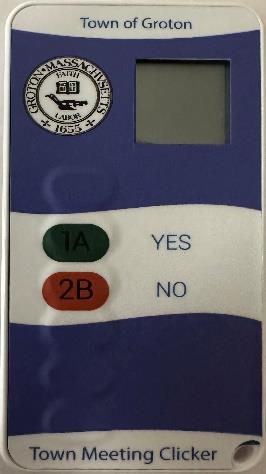
Voters attending Town Meeting must first check in with the clerks and receive an electronic voting handset which is required to vote.

The meeting typically acts on the articles in the order they are printed in the warrant. For each article, a main motion is made and seconded by voters and placed by the Moderator on the floor for debate.

Permission of the Moderator is required to speak. The Moderator presides and regulates the proceedings, decides all questions of order, and calls and declares all votes.

After debate has ended, the Moderator will call for a vote by use of the electronic voting handset.

What is a Warrant?

The warrant is the official notice to voters that a Town Meeting is scheduled.

The warrant includes the date, time, location and a description of each subject to be acted on at Town Meeting.

In Groton, the warrant must be posted in two public places and mailed to each household 14 days in advance of Town Meeting.

“The warrant must contain a sufficient description of what is proposed so as to constitute an adequate warning to all the inhabitants of the town.”

“Every action taken at the meeting must be pursuant to some article in the warrant and must be within the scope of such article.”

What is Town Meeting?

The Town Meeting is the legislative body in the town form of government in Massachusetts.

Town Meeting is a formal gathering of registered voters who propose, debate and vote on measures.

Groton holds at least two Town Meetings per year.

How long is Town Meeting?

Town Meeting concludes when all articles on the warrant have been acted upon.

Town Meeting may conclude in one session or adjourn for subsequent sessions.

How does Town Meeting Proceed?

Voters attending Town Meeting must first check in with the clerks and receive an electronic voting handset which is required to vote.

The meeting typically acts on the articles in the order they are printed in the warrant. For each article, a main motion is made and seconded by voters and placed by the Moderator on the floor for debate.

Permission of the Moderator is required to speak. The Moderator presides and regulates the proceedings, decides all questions of order, and calls and declares all votes.

After debate has ended, the Moderator will call for a vote by use of the electronic voting handset.

Electronic Voting at Town Meeting

Voting at Town Meeting will be conducted using an electronic voting system purchased by the Town of Groton as authorized by Town Meeting in October, 2022.

Instead of using placards to be raised and counted, voters will use wireless handsets to cast their vote quickly, accurately and privately.

Voter Check-In

At check-in, voters will be given a handset.

No record is made of which voter receives which handset.

All handsets will be tested prior to the meeting.

Voters physically unable to use a handset will be
seated in a manual-count section and their votes will be counted by tellers.

For those with visual impairments, large handsets with braille are available.

Test Vote

At the beginning of the meeting, the Moderator will conduct a test vote to get everyone comfortable with the voting
procedures.

Help Desk

A Help Desk will be able to assist voters who have trouble with using the handset.

If a handset malfunctions, a voter will receive a new handset.

Handset Return

If you leave the meeting temporarily, please keep the
handset with you.

If the meeting ends or you leave, return the handset to the check-in table.

Proxy Voting Prohibited

The handset given to a voter at check-in is for the exclusive use of that voter.

Voting with a handset that has been issued to another individual is strictly forbidden.

Voting

When the Moderator announces it is time to vote:

  • Press 1A (Green Button) for YES
  • Press 2B (Red Button for NO)
  • If you wish to NOT vote, press no buttons.

Handset Display

The display on the handset:

  • OK means the system receiver has received your vote.
  • a “1” for YES or “2” for NO, shows the vote the system received.
  • The small “R” at the top of the screen indicates the handset is communicating with the receiver.
  • The icons in the top left indicate the signal strength.

Town Meeting Access for Voters with Disabilities

Parking

Universally accessible parking spaces are available in the parking lot in front of the Groton Dunstable Marion Stoddart Building.

There is a ramp providing access from the parking lot to the front door of the Building.

Wheelchair Accessible & Companion Seating

Wheelchair spaces, seating for people with mobility issues and companion seats are available in the center aisle on both sides of the auditorium.

Sign Language

A Sign Language Interpreter will be provided for the hearing impaired, upon request, at least one week prior to the meeting.

Speaking at Town Meeting

There will be volunteers available to bring hand-held microphones to voters who have mobility issues or cannot stand in line and wait at the microphones.

Restrooms

Accessible restrooms are available near the entrance to the auditorium.

Transportation to Town Meeting

The Council on Aging van will be available to Groton residents attending Town Meetings at no charge.

All riders will be at the meeting prior to the start.

The van is wheelchair accessible.

Your reservation can be made by calling the Senior Center at 978-448-1170.

Seats will be filled on a first come, first serve basis.

Questions or Concerns

If you or a member of your household has questions or would like to request a sign language interpreter.

Please contact the Select Board’s Office at Town Hall at 978 448-1111 at least one week before the Town Meeting.

Articles

To see if the Town will vote to transfer from available funds a sum or sums of money for the payment of unpaid bills from prior fiscal years, or to take any other action relative thereto.

Select Board

Select Board: Recommended Unanimously

Finance Committee: Recommended Unanimously

Summary: Town Meeting approval is required to pay bills from a prior fiscal year. A list of unpaid bills will be provided at Town Meeting. Please see the Town Manager’s Report starting on page 29 for additional information related to this Article.

To see if the Town will vote to amend the Fiscal Year 2027 Operating Budget as adopted under Article 5 of the May 2, 2026 Spring Town Meeting and vote to raise and appropriate and/or transfer from available funds a sum or sums of money as may be necessary to defray the expenses of the Town for Fiscal Year 2027, or to take any other action relative thereto.

Select Board/Finance Committee/Town Manager

Select Board: See Select Board’s Recommendations Beginning on Page 29

Finance Committee: See Finance Committee’s Recommendations Beginning on Page 29

Summary: The Fiscal Year 2027 Town Operating Budget was approved at the May 2, 2026 Town Meeting. Any changes to this Budget would have to be made prior to setting the tax rate. The purpose of this article is to make any necessary changes to balance the Fiscal Year 2027 Operating Budget. Please see the Town Manager’s Report starting on page 29 for additional information related to this Article.

To see if the Town will vote to raise and appropriate, transfer from available funds, and/or borrow, pursuant to any applicable statute, a sum or sums of money to be added to the sum already on deposit in the Capital Stabilization Fund, or to take any other action relative thereto.

Select Board

Select Board: Recommended Unanimously

Finance Committee: Recommended Unanimously

Summary: As of the printing of this Warrant, the Fund has a balance of $144,028. The financial management goal is to achieve and maintain a balance in the Capital Stabilization Fund equal to 1.5% of the total annual budget. The target amount for the Capital Stabilization Fund will be provided at Town Meeting. Please see the Town Manager’s Report starting on page 29 for additional information related to this Article.

To see if the Town will vote to raise and appropriate, transfer from available funds, and/or borrow, pursuant to any applicable statute, a sum or sums of money to be added to the sum already on deposit in the Stabilization Fund, or to take any other action relative thereto.

Select Board

Select Board: Recommended Unanimously

Finance Committee: Recommended Unanimously

Summary: As of the printing of this Warrant, the balance in this fund is $2,873,587. The financial management goal is to achieve and maintain a balance in the Fund equal to 5% of the total annual budget. The target amount for the Fund will be provided at Town Meeting. Please see the Town Manager’s Report starting on page 29 for additional information related to this Article.

To see if the Town will vote to raise and appropriate, transfer from available funds, and/or borrow, pursuant to any applicable statute, a sum or sums of money to be added to the sum already on deposit in the Town of Groton Capital Stabilization Fund for the Groton Dunstable Regional School District, or to take any other action relative thereto.

Town Manager

Select Board: Recommended Unanimously

Finance Committee: Recommended Unanimously

Summary: As of the printing of the Warrant, the balance in this fund is $26,593. This fund covers the Town of Groton’s share of the Groton Dunstable Regional School District Committee’s long-range Capital Plan to address its capital needs. The target amount will be provided at Town Meeting. Please see the Town Manager’s Report starting on page 29 for additional information related to this Article.

To see if the Town will vote to transfer a sum or sums of money from the Water Enterprise Fund Surplus to the Fiscal Year 2027 Water Enterprise Budget, or to take any other action relative thereto.

Board of Water Commissioners

Select Board: Recommended Unanimously

Finance Committee: Recommended Unanimously

Summary: This Article will seek a transfer from the Water Enterprise Fund Surplus to the Fiscal Year 2027 Water Department’s General Expense Budget to cover unanticipated expenses. Please see the Town Manager’s Report starting on page 29 for additional information related to this Article.

To see if the Town will vote to transfer a sum or sums of money from the Four Corners Sewer Enterprise Fund Surplus to the Fiscal Year 2027 Four Corners Sewer Enterprise Department Budget, or to take any other action relative thereto.

Board of Sewer Commissioners

Select Board: Recommended Unanimously

Finance Committee: Recommended Unanimously

Summary: This article allows the Sewer Department to transfer money from its surplus account to cover any deficit in the Fiscal Year 2027 Four Corners Sewer Budget. Please see the Town Manager’s Report starting on page 29 for additional information related to this Article.

To see if the Town will vote to transfer a sum or sums of money from the Stormwater Enterprise Fund Surplus to the Fiscal Year 2027 Stormwater Enterprise Budget, or to take any other action relative thereto.

Town Manager

Select Board: Recommended Unanimously

Finance Committee: Recommended Unanimously

Summary: This article allows the Stormwater Department to transfer money from its surplus account to cover any deficit in the Fiscal Year 2027 Stormwater Budget. Please see the Town Manager’s Report starting on page 29 for additional information related to this Article.

To see if the Town will vote to appropriate a sum or sums of money from Receipts Reserved for the Town Forest to Town Forest Expenses, or to take any other action relative thereto.

Town Manager

Select Board: Recommended Unanimously

Finance Committee: Recommended Unanimously

Summary: The Town Forest Committee is seeking to transfer funds from Receipts Reserved for the Town Forest to cover the costs of removing a stand of dead Red Pines that are creating a hazard, and for future forest maintenance projects. The transfer amount requested is $30,000, with $12,238 coming from a reimbursement already received from the Division of Conservation and Recreation for a 2026 Forest Stewardship Plan.

To see if the Town will vote to adopt and approve the recommendation of the Community Preservation Committee for improvements to the Cow Pond Brook Fields as described in CPA Application 2027-11, on file in the Town Clerk’s Office, and vote to implement such recommendations by appropriating a sum or sums of money from the Community Preservation Fund established pursuant to Chapter 44B of the Massachusetts General Laws, and/or borrow pursuant to any applicable statute a sum or sums of money, to be expensed by the Town Manager, for said purposes, and all costs associated and related thereto, and further to authorize the transfer of the real property identified as Assessor’s Parcel 249-51 along Hoyts Warf Road, containing approximately 10.4 acres, from the Parks Commission to the Conservation Commission, or to take any other action relative thereto.

Community Preservation Committee/Parks Commission

Select Board: Recommended Unanimously

Finance Committee: Recommendation Deferred Until Town Meeting

Summary: This article requests Community Preservation Act (CPA) funding for a revised improvement project at the Cow Pond Brook Fields recreational complex. A similar proposal was not approved at the 2026 Spring Town Meeting. In response, the Parks Commission and Town Manager worked with user groups, Town departments, consultants, and other stakeholders to reduce costs and refine the project while preserving the improvements most important to the long-term use of the facility. That effort has produced significant savings. The original project was estimated at approximately $4.8 million. Following revisions to the project and competitive bidding, bids came in approximately $300,000 below the revised estimate, lowering the funding request to $3.9 million. In addition, the Groton Dunstable Youth Baseball League has committed $20,000 toward the new field lighting. The revised project will rehabilitate and modernize one of the Town’s most heavily used recreational facilities, including improvements to the access road, ADA accessibility, drainage, parking, traffic circulation, field lighting, and other supporting infrastructure. Importantly, approval will also preserve a $1 million federal grant already awarded to the project. If the project does not proceed, the Town will lose these funds. The revised proposal directly responds to the concerns raised at the Spring Town Meeting: the scope has been refined, the cost has been substantially reduced, competitive bids have established the actual project cost, and more than $1 million in outside funding has been secured. Approval will allow the Town to leverage these outside funds and make a long-term investment in an important recreational asset that serves residents, schools, youth organizations, and community groups.

To see if the Town will vote to raise and appropriate, transfer from available funds and/or borrow a sum or sums of money, to be expended by the Town Manager, to install an irrigation system and make various improvements to the Groton Country Club Golf Course, and all costs associated and related thereto, or to take any other action relative thereto.

Town Manager/Head Professional/Garden Manager

Select Board: Recommended Unanimously

Finance Committee: Recommended Unanimously

Summary: This article requests funding to construct a new irrigation system and complete targeted course improvements at the Groton Country Club. The Club’s existing irrigation system provides only limited coverage and requires manual operation, making it difficult to maintain consistent playing conditions, particularly during dry weather. The proposed irrigation system would be fully automated, allowing watering during non-playing hours, and would provide comprehensive coverage of all greens, tee boxes, fairways, and selected in-play rough areas. The project is intended to improve turf health, course conditions, water management, and the overall quality of the golf course. In addition to the irrigation system, the project includes targeted improvements to enhance playability and course infrastructure. These include redesigning portions of Holes 1 through 3 to improve playability and installing a drainage system on Hole 7 to address persistent drainage issues. Based on bids received prior to Town Meeting, the cost for the project is $1.7 million. If approved, the project would be financed through borrowing. Annual debt service would be appropriated through the Town’s Capital Budget and funded from Free Cash. The project is intended to protect the Town’s investment in the municipal golf course, enhance the experience for residents and visitors, and support the Club’s long-term operational and financial sustainability.

To see if the Town will vote to authorize the Select Board to petition the General Court of the Commonwealth of Massachusetts for the following Special Act, provided, however, that the General Court may make clerical or editorial changes of form only to the bill, unless the Select Board approves amendments thereto before enactment by the General Court, which amendments shall be within the public purposes of said petition:

AN ACT AUTHORIZING THE TOWN OF GROTON TO ESTABLISH A MEANS-TESTED SENIOR CITIZEN PROPERTY TAX EXEMPTION

Be it enacted by the Senate and House of Representatives in General Court assembled, and by the authority of the same, as follows:

Section 1. 

(a) With respect to each qualifying parcel of real property classified as residential in the town of Groton, and as established more specifically by the select board annually pursuant to section 2, there shall be an exemption from the property tax equal to the total amount of tax that would otherwise be assessed without this exemption plus 50 per cent of the annual water and sewer expense less the sum of: (i) 10 per cent of income or other such percentage of income as determined pursuant to section 3; (ii) the circuit breaker income tax credit pursuant to subsection (k) of section 6 of chapter 62 of the General Laws the applicant received for the year prior to the year for which the application is being filed; and (iii) any other statutory exemptions or other forms of property tax relief including the senior tax work off program.

(b) In no event shall this exemption be greater than the cap established on an annual basis by the select board pursuant to section 5. The exemption shall be applied to the domicile of the taxpayer only. For the purposes of this act, “parcel” shall mean a unit of real property as defined by the board of assessors under the deed for the property and shall include a condominium unit. The exemption provided for in this section shall be in addition to any other exemptions allowed pursuant to the General Laws, unless otherwise removed from the calculation in subsection (a).

Section 2.

The board of assessors of the town of Groton may deny an application for exemption if the board finds that the applicant has excessive assets that place the applicant outside of the intended recipients of the senior exemption established pursuant to this act. For the purposes of this act, what constitutes excessive assets shall be determined by regulations set by the select board. Real property shall qualify for the exemption pursuant to section 1 if all of the following criteria are met:

  1. the qualifying real property is owned and occupied by a person whose annual household income does not exceed limitations established by the select board pursuant to section 5;
  2. the qualifying real property is owned by a single applicant who was 65 years of age or older at the close of the previous year or jointly by persons who are 60 years of age or older; provided, that not less than 1 joint owner was 65 years of age or older at the close of the previous year;
  3. the qualifying real property is owned and occupied by the applicant or joint applicants as their domicile;
  4. the applicant, or at least 1 of the joint applicants, has been domiciled and owned a home in the town of Groton for not less than 10 consecutive years before filing an application for the exemption;
  5. the maximum assessed value of the domicile is not greater than the prior year’s average assessed value of a town of Groton single family residence;
  6. the applicant files for circuit breaker income tax credit pursuant to subsection (k) of chapter 62 of the General Laws, if eligible; and
  7. the board of assessors approves the application for the exemption.

Section 3.

The exemption pursuant to section 1 shall be in addition to any other exemption allowable pursuant to the General Laws, except that there shall be a dollar cap for all real estate exemptions available pursuant to this act as set annually by the select board of the town of Groton pursuant to section 5. If benefits to the applicants are limited because the cap established annually by the select board would otherwise be exceeded, the benefits shall be decreased pro rata.

Section 4.

A person who seeks to qualify for the exemption pursuant to section 1 shall, before the deadline established by the board of assessors of the town of Groton, file an application, on a form adopted by the board of assessors, with the supporting documentation as described in the application. The application shall be filed each year for which the applicant seeks the exemption.

Section 5.

The select board may, after consultation with the board of assessors and after holding a public hearing for which notice of not less than 7 days provided, promulgate rules and regulations to implement this act.

Section 6.

This act shall take effect upon its passage. Or to take any other action relative thereto.

Select Board

Select Board: Recommended Unanimously

Finance Committee: Recommendation Deferred Until Town Meeting

Summary: This article requests Town Meeting approval to petition the Massachusetts General Court for special legislation authorizing the Town of Groton to establish a local, means-tested property tax exemption for qualifying senior homeowners. If enacted by the Legislature, the program would provide an annual property tax exemption to eligible seniors who meet income, age, residency, ownership, occupancy, and property value requirements. To qualify, applicants generally must meet the income eligibility requirements for the Massachusetts Senior Circuit Breaker Tax Credit; own and occupy the property as their primary residence; be at least 65 years of age (or, in the case of jointly owned property, at least one owner must be 65 and all owners at least 60 years of age); have owned and resided in a home in Groton for at least ten consecutive years; own a home with an assessed value within the annual limits established for the state Circuit Breaker Tax Credit; and, submit an annual application and supporting documentation to the Board of Assessors. The Board of Assessors would administer the program and may deny an application if it determines the applicant possesses excessive assets inconsistent with the program’s intended purpose. The Select Board would annually establish the amount of the exemption. The exemption must be between 50% and 200% of the applicant’s prior year’s Massachusetts Senior Circuit Breaker Tax Credit. The cost of the exemption would be funded through a proportional shift within the residential property tax levy, resulting in an increase in the residential tax burden shared among all other residential taxpayers. The exemption would supplement, rather than replace, any other property tax exemptions for which an applicant may qualify. The special act would become effective only upon approval by the Massachusetts Legislature and the Governor. The authorization would remain in effect for three years, after which Town Meeting would need to vote to reauthorize the program for additional three-year periods.

To see if the Town will vote to amend the Zoning Bylaws of the Town of Groton as follows:

1. Amend Section 218-3 Definitions by inserting the following definitions in alphabetical order:

Small Clean Energy Facility
Includes the Clean Energy Uses as defined in State Regulations 225 CMR 29.02 governing the Small Clean Energy Infrastructure Facility Siting and Permitting. Generation facilities with a nameplate capacity of less than 25 kilowatts (kW) and storage facilities with a rated capacity of less than 100 kilowatt hours (kWh) shall be exempt from site plan review.

Battery Energy Storage System (BESS)
One or more containers or cabinets on a lot containing batteries and related equipment, assembled together, capable of storing electrical energy in order to supply electrical energy to the power grid at a future time. This includes all accessory equipment on said lot necessary for energy storage including but not limited to inverters, transformers, cooling equipment, switching gear, metering equipment, transmission tie-lines, and other power interconnection facilities and/or a project substation, but does not include public utility owned and operated interconnection equipment, regardless of location, or other interconnection equipment to be located on the real property of the public utility or within its right of way, determined to be necessary by the public utility to facilitate the BESS interconnection with the power grid whether for bringing power to the BESS or for returning it to the power grid, a stand-alone 12-volt vehicle battery, or an electric motor vehicle.

Consolidated Local Permit Application
Consolidated Local Permit Applications for Small Clean Facility shall be completed and submitted by the Applicant in accordance with the requirements of 225 CMR 29.09 and the requirements of all Local Boards, Commissions, Departments that have been identified as having jurisdiction for the proposed facility. It is strongly recommended the Applicant seek pre-submission meetings with the Land Use Committee to identify/confirm the applicable jurisdictional authorities that will be involved in the consolidated permitting process. For this purpose, the Town’s Land Use Director shall serve as the Local Government Representative.

2. Amend Section 218—5.2 Schedule of Use Regulations by inserting the following entry in the Section titled “Industrial” after the last entry and renumbering subsequent entries accordingly:

(XX)           USER-A10R-B10NBVCB10GBIP10O
Small Clean Energy FacilityYYYYYYYY

3. Amend Section 218-10 Special Regulations by inserting a new Section 218-10.2 and renumbering subsequent sections accordingly to read as follows:

218-10.2
Small Scale Clean Energy Facility
An Applicant for a Small Clean Energy Facility shall complete all pre-filing requirements specified in 225 CMR29.08 before submitting a Consolidated Local Permit Application to the Planning Board for Major Site Plan Review. A Consolidated Local Permit Application submitted before the completion of all pre-filing requirements shall automatically be denied without prejudice. Applicants are strongly encouraged to seek pre-submission meetings with the appropriate local authorities having jurisdiction in advance of filing the Consolidated Local Permit Application.

4. Amend Section 218-2.5 Site Plan Review under Section 518-2.5.C.(2) Threshold of Review/Major by deleting section (c) and (d) in their entirety and inserting the following entry to read as follows and renumber subsequent sections accordingly:

“(c) Small Clean Energy Facility.”

5. Amend Section 218-10 Special Regulations by inserting a new Section 218-10.4 to read as follows and renumbering subsequent Sections accordingly:

218-10.5 Battery Energy Storage Systems (BESS)

A. Applicability. The requirements of this bylaw shall apply to battery energy storage systems permitted, installed, decommissioned, or modified after the effective date of this bylaw, excluding general maintenance and repair. BESS subject to this bylaw are only those that exceed the following capacities:

  • Lead-acid with a capacity of greater than 100 kWh• Nickel with a capacity of greater than 100 kWh
  • Lithium-ion with a capacity of greater than 100 kWh
  • Sodium nickel chloride with a capacity of greater than 100 kWh
  • Flow with a capacity of greater than 100 kWh

BESS with lower storage capacity are exempt from regulation under this bylaw. BESS with a storage capacity of 100 MWh or greater will be subject to review and approvals from the Energy Facilities Siting Board (EFSB) pursuant to 225 CMR 29.00.

B. General Requirements.

  1. All permits required by state codes, including but not limited to building
    permit, an electrical permit, and a fire department permit shall be required for installation of all battery energy storage systems.
  2. All battery energy storage systems, all dedicated use buildings, and all other
    structures that contain or are otherwise associated with a battery energy storage system and subject to the requirements of the State Building Code, shall be designed, erected, and installed in accordance with all applicable provisions of the State Building Code 780 CMR, State Fire Code 527 CMR 1.00, and State Electrical Code 527 CMR 12.00. All battery energy storage systems shall comply with NFPA 855, Standard for the Installation of Stationary Energy Storage Systems.
  3. Energy storage system capacities, including array capacity and separation, are limited to the thresholds contained in NFPA 855.
  4. Utility Lines and Electrical Circuitry. All on-site utility lines shall be placed
    underground to the extent feasible and as permitted by the serving utility, with the exception of the main service connection at the utility company right-of-way and any new interconnection equipment, including without limitation any poles.

C. Permitting Requirements for Small Scale BESS

  1. Small Scale BESS are allowed as of right in all zoning districts subject
    to applicable provisions of the State Building Code, Electrical Code, Fire Code, and other applicable codes, and are subject to Major Site Plan Review pursuant to section 218-2.5 of this bylaw as applicable.
  2. Utility Lines and Electrical Circuitry. All on-site utility lines shall be placed
    underground to the extent feasible and as permitted by the serving utility, with the exception of the main service connection at the utility company right-of-way and any new interconnection equipment, including without limitation any poles.
  3. Signage. Signage shall comply with the requirements Groton Signage Bylaw, Chapter 196 of the Groton General Bylaws and the following requirements: in the event of a conflict between the provisions of Chapter 196 and this section, the requirements of this Section shall prevail

a. The signage shall be in compliance with ANSI Z535 and shall include the type of technology associated with the battery energy storage systems, any special hazards associated, the type of suppression system installed in the area of battery energy storage systems, and 24hour emergency contact information, including reach back phone number.
b. As required by the state electrical code, disconnect and other emergency shutoff information shall be clearly displayed on a light reflective surface. A clearly visible warning sign concerning voltage shall be placed at the base of all pad-mounted transformers and substations.
c. Signage compliant with ANSI Z535 shall be provided on doors to rooms, entrances to BESS facilities, and on BESS outdoor containers

4. Lighting. Lighting of the battery energy storage systems shall be limited to that minimally required for safety, security and operational purposes and shall comply with Section 218-2.5.H.1.i of this Zoning Bylaw.

5. Setbacks. SmallScale Battery Energy Storage Systems shall be set back a minimum of 50 feet from all side, rear, and front lot lines. In addition, a minimum of 10 feet must be maintained between BESS components and all buildings, stored combustible materials, hazardous materials, high-piled storage, personnel means of egress, and other exposure hazards not associated with electrical grid infrastructure.

6. Dimensional. Battery Energy Storage Systems shall comply with the dimensional limitations or principal structures of the underlying zoning district as provided in Section218-6 of this Zoning Bylaw, unless otherwise provided in this bylaw.

7. Screening and Visibility. Small Scale Battery Energy Storage Systems shall have views minimized from adjacent properties to the extent reasonably practicable using architectural features, earth berms, landscaping, or other screening methods that will harmonize with the character of the property and surrounding area. Such features may not inhibit required air flow to or exhaust from the BESS and components and must comply with the setbacks established above,

8. Mitigation for Loss of Carbon Sequestration and Forest Habitat. If land that is Forestland or has been Forestland within one year immediately preceding the filing an application to install a BESS, the plans shall designate thereon an area of unprotected (meaning, not subject to G.L. c. 184, sections 31-33 at time of application) land on the same lot and of a size equal to two times the total area of Forestland that will be eliminated, cut, destroyed, or otherwise disturbed by such installation. Such designated land shall remain in substantially its natural condition without alteration, including prohibition of commercial forestry or tree cutting not related to the maintenance of the installation, until such time as the installation is decommissioned; except in response to a natural occurrence, invasive species or disease that impacts the trees and requires cutting to preserve the health of the forest.

9. Fire Protection: Any such building, built or modified as a BESS shall have a full fire protection system, designed and engineered to meet the hazard regardless of building size. Any facility located in an area not served by a municipal water supply shall install a cistern of not less than 20,000 gallons for fire protection systems and firefighting operations. Cisterns shall be sized accordingly for fire protection based on the Large-scale-fire test data and modeling

10. Batteries. Failed battery cells and modules shall not be stored on the site and shall be removed no later than 30 days after deemed failed by the BESS operator or cell/module manufacturer. The operator shall notify the Groton Fire Department in advance if the type of battery or batteries used onsite is to be changed.

11. Decommissioning Plan. The applicant shall submit with its application a decommissioning plan for a BESS to be implemented upon abandonment and/or in conjunction with removal of the facility. The owner or operator of the BESS shall notify the Building Inspector in writing at least twenty days prior to when a Small Scale BESS will be decommissioned. Decommissioning of an abandoned or discontinued BESS shall be completed within six months after the facility ceases operation. The decommissioning plan shall include:

a. A narrative description of the activities to be accomplished, including who
will perform that activity and at what point in time, for complete physical removal of all battery energy storage system components, structures, equipment, security barriers, and transmission lines from the site;
b. Disposal of all solid and hazardous waste in accordance with local, state, and federal waste disposal regulations; The anticipated life of the battery energy storage system;
c. The estimated decommissioning costs and how said estimate was determined;
d. The method of ensuring that funds will be available for decommissioning and restoration;
e. The method by which the decommissioning cost will be kept current;
f. The manner in which the site will be restored, including a description of
how any changes to the surrounding areas and other systems adjacent to the battery energy storage system, such as, but not limited to, structural elements, building penetrations, means of egress, and required fire detection suppression systems, will be protected during decommissioning and confirmed as being acceptable after the system is removed; and
g. A listing of any contingencies for removing an intact operational energy storage system from service, and for removing an energy storage system from service that has been damaged by a fire or other event.

12. Decommissioning Fund. The owner and/or operator of the energy storage system shall continuously maintain a fund or other surety acceptable to the Town, in a form approved by the Planning Board and Town Counsel, for the removal of the battery energy storage system, in an amount to be determined by the Town, for the period of the life of the facility. All costs of the financial security shall be borne by the applicant.

13. Proof of Liability Insurance. The applicant or property owner shall provide evidence of commercial liability insurance in an amount and type generally acceptable in the industry and approved by the Planning Board prior to the issuance of a building permit, and shall continue such insurance in effect until such facility has been decommissioned, removed, and the site restored in accordance with this bylaw.

D. Site plan application. For a Small Scale Battery Energy Storage System, the site plan application shall include the following information, in addition to that required elsewhere in this Zoning Bylaw and the Planning Board Rules and Regulations:

1. A one or three-line electrical diagram detailing the battery energy storage system layout, associated components, and electrical interconnection methods, with all State Electrical Code compliant disconnects and over current devices.
2. A preliminary equipment specification sheet that documents the proposed battery energy storage system components, inverters and associated electrical equipment that are to be installed. A final equipment specification sheet shall be submitted prior to the issuance of building permit.
3. Name, address, and contact information of proposed or potential system installer and the owner and/or operator of the battery energy storage system. Such information of the final system installer shall be submitted prior to the issuance of building permit.

E. Commissioning Plan. The system installer or commissioning agent shall prepare a commissioning plan prior to the start of commissioning. Such plan shall be compliant with NFPA 855 and document and verify that the system and its associated controls and safety systems are in proper working condition per requirements set forth in applicable state codes. Where commissioning is required by the Building Code, battery energy storage system commissioning shall be conducted by a Massachusetts Licensed Professional Engineer after the installation is complete but prior to final inspection and approval. A corrective action plan shall be developed for any open or continuing issues that are allowed to be continued after commissioning. A report describing the results of the system commissioning and including the results of the initial acceptance testing required by applicable state codes shall be provided to the Building Inspector prior to final inspection and approval and maintained at an approved on-site location.

F. Fire Safety Compliance Plan. Such plan shall document and verify that the system and its associated controls and safety systems are in compliance with state codes, including documentation that BESS components comply with the safety standards set forth in subsection 218-10. L.

G. Operation and Maintenance Manual. Such plan shall describe continuing battery energy storage system maintenance and property upkeep, as well as design, construction, installation, testing and commissioning information and shall meet all requirements set forth state codes and NFPA 855. Maintenance provisions will be driven by manufacturer requirements for the specific listed system

H. Depending on the location of the BESS in relation to and its interaction with the electrical grid, interconnection will be completed per 527 CMR 12.00. System interconnections into utility grids shall be in accordance with NFPA 855. An accessible disconnect is required per 527 CMR 12.00.

I. Prior to the issuance of the building permit, engineering documents must be signed and sealed by a Massachusetts Licensed Professional Engineer.

J. Emergency Operations Plan. An Emergency Operations Plan compliant with NFPA 855 is required. A copy of the approved Emergency Operations Plan shall be given to the system owner, the local fire department, and local fire code official. For so long as the BESS is operational, the operator shall provide the Fire Department, Police Department, Building Inspector, and Town Manager’s office with contact information for personnel that can be reached 24 hours per day every day, and this contact information shall be updated by the operator whenever there is a change in the information. The operator shall also be required to have an official representative be present onsite not later than two hours after notification by the Fire Chief, Police Chief, or their designee. A permanent copy shall also be placed in an approved location to be accessible to facility personnel, fire code officials, and emergency responders. The emergency operations plan shall include the following information:

1. Procedures for safe shutdown, de-energizing, or isolation of equipment and systems under emergency conditions to reduce the risk of fire, electric shock, and personal injuries, and for safe start-up following cessation of emergency conditions.
2. Procedures for inspection and testing of associated alarms, interlocks, and controls, including time intervals for inspection and testing.
3. Procedures to be followed in response to notifications from the Battery Energy Storage Management System, when provided, that could signify potentially dangerous conditions, including shutting down equipment, summoning service and repair personnel, and providing agreed upon notification to fire department personnel for potentially hazardous conditions in the event of a system failure.
4. Emergency procedures to be followed in case of fire, explosion, release of liquids or vapors, damage to critical moving parts, or other potentially dangerous conditions. Procedures can include sounding the alarm, notifying the fire department, evacuating personnel, de-energizing equipment, and controlling and extinguishing the fire.
5. Response considerations similar to a safety data sheet (SDS) that will
address response safety concerns and extinguishment when an SDS is not required.
6. Procedures for safe disposal of battery energy storage system equipment damaged in a fire or other emergency event, including maintaining contact information for personnel qualified to safely remove damaged battery energy storage system equipment from the facility.
7. Other procedures as determined necessary by the Town to provide for the safety of occupants, neighboring properties, and emergency responders.
8. Procedures and schedules for conducting drills of these procedures and for training local first responders on the contents of the plan and appropriate response procedure.

K. Ownership Changes. If the owner of the battery energy storage system changes or the owner of the property changes, the Site Plan Review approval conditionsshall remain in effect, provided that the successor owner or operator assumes in writing all of the obligations of the site plan approval conditions, and decommissioning plan. A new owner or operator of the battery energy storage system shall notify the Building Commissioner of such change in ownership or operator within 14 days of the ownership change. A new owner or operator must provide such notification to the Building Inspector in writing.

L. Safety

1. System Certification. Battery energy storage systems and equipment shall be listed by a Nationally Recognized Testing Laboratory to UL 9540 (Standard for battery energy storage systems and equipment) or approved equivalent, with subcomponents meeting each of the following standards as applicable:

a. UL 1973 (Standard for Batteries for Use in Stationary, Vehicle Auxiliary Power and Light Electric Rail Applications),
b. UL 1642 (Standard for Lithium Batteries),
c. UL 1741 or UL 62109 (Inverters and Power Converters),
d. Certified under the applicable electrical, building, and fire prevention codes as required.
e. Alternatively, field evaluation by an approved testing laboratory for compliance with UL 9540 (or approved equivalent) and applicable codes, regulations and safety standards may be used to meet system certification requirements.

2. Site Access. Battery energy storage systems shall be maintained in
good working order and in accordance with industry standards. Site access shall be maintained, including snow removal at a level acceptable to the local fire
department.

3. Battery energy storage systems, components, and associated ancillary equipment shall have required working space clearances, and electrical circuitry shall be within weatherproof enclosures marked with the environmental rating suitable for the type of exposure in compliance with NFPA 70.

M. Abandonment.
The battery energy storage system shall be considered abandoned when it ceases to operate consistently for more than one year. If the owner and/or operator fails to comply with decommissioning upon any abandonment, the Town may, after compliance with any applicable state and federal constitutional requirements, enter the property and utilize the available bond and/or security for the removal of a BESS and restoration of the site in accordance with the decommissioning plan. or to take any other action relative thereto.

Planning Board

Select Board: Recommended Unanimously

Finance Committee: No Position

Planning Board: Recommended Unanimously

Summary: This article proposes amendments to the Town’s Zoning Bylaw to bring Groton’s regulations into compliance with new Massachusetts requirements governing the siting and permitting of small clean energy facilities. The amendments establish definitions and local permitting procedures for small clean energy generation, energy storage, and certain transmission and distribution facilities, including a consolidated local permitting process and Major Site Plan Review by the Planning Board. The article also updates the Town’s regulations for Battery Energy Storage Systems (BESS), including applicable size thresholds and requirements for setbacks, screening, fire protection, emergency response, safety, decommissioning, financial security, and other measures intended to protect neighboring properties and the community. The purpose of these amendments is to comply with the Commonwealth’s new clean energy siting requirements while maintaining appropriate local review and reasonable protections for public safety, the environment, and surrounding properties.


To see if the Town will vote to amend Section 218-10.3, Large-Scale Ground Mounted Solar Photovoltaic Facilities, of the Zoning Bylaws of the Town of Groton with the tracked changes as follows:

§ 218-10.3 LargeSmall-Scale Ground-Mounted Solar Photovoltaic Facilities.

A. Purpose. The purpose of this section is to promote the creation of new largeregulate small-scale ground-mounted solar photovoltaic installations by providing standards for the placement, design, construction, operation, monitoring, modification and removal of such installations that address public safety, minimize impacts on scenic, natural and historic resources and to provide adequate financial assurance for the eventual decommissioning of such installations. The provisions set forth in this section shall apply to the construction, operation, and/or repair of largesmall-scale ground-mounted solar photovoltaic installations.

B. Applicability. This section applies to smalllarge-scale ground-mounted solar photovoltaic installations proposed to be constructed after the effective date of this section. This section also pertains to physical modifications that materially alter the type, configuration, or size of these installations or related equipment. Small scale solar ground mounted photovoltaic installations subject to this bylaw are only those that exceed a minimum nameplate capacity of 250 kw DC and do not exceed 25 MW. Ground mounted solar photo voltaic installations with a minimum nameplate capacity exceeding 25 MW shall be regulated by the Energy Facilities Siting Board.

1. General requirements for all smalllarge-scale solar power generation installations. The following requirements are common to all solar photovoltaic installations to be sited in designated locations.

1.1 Compliance with laws, ordinances and regulations. The construction and operation of all largesmall-scale solar photovoltaic installations shall be consistent with all applicable local, state and federal requirements, including but not limited to all applicable safety, construction, electrical, and communications requirements. All buildings and fixtures forming part of a solar photovoltaic installation shall be constructed in accordance with the State Building Code.

1.2 Building permit and building inspection. No largesmall-scale solar photovoltaic installation shall be constructed, installed or modified as provided in this section without first obtaining appropriate permits.

1.3 Fees. The application for a building permit for a largesmall-scale solar photovoltaic installation must be accompanied by the fee required for a building permit.

1.4 Site plan review. Ground-mounted largesmall-scale solar photovoltaic installations with 250 kW or larger and no greater than 25 MW of rated nameplate capacity shall undergo site plan review by the Planning Board prior to construction, installation orissuance of a building permit or modification as provided in this section.

1.4.1 General. All plans and maps shall be prepared, stamped and signed by a professional engineer licensed to practice in Massachusetts.

1.4.2 Required documents. Pursuant to the site plan review process, the project proponent shall provide the following documents:

(a) A site plan showing:
i. Property lines and physical features, including roads, for the project site;
ii. Proposed changes to the landscape of the site, grading, vegetation clearing and planting, exterior lighting, screening vegetation or structures;
iii. Blueprints or drawings of the solar photovoltaic installation signed by a professional engineer licensed to practice in the Commonwealth of Massachusetts showing the proposed layout of the system and any potential shading from nearby structures
iv. One or three line electrical diagram detailing the solar photovoltaic installation, associated components, and electrical interconnection methods, with all National Electrical Code compliant disconnects and overcurrent devices;
v. Documentation of the major system components to be used, including the PV panels, mounting system, and inverter;
vi. Name, address, and contact information for proposed system installer;
vii. Name, address, phone number and signature of the project proponent, as well as all co-proponents or property owners, if any;
viii. The name, contact information and signature of any agents representing the project proponent; and
(b) Documentation of actual or prospective access and control of the project site (see also Subsection 1.5);
(c) An operation and maintenance plan (see also Subsection 1.6);
(d) Zoning district designation for the parcel(s) of land comprising the project site [submission of a copy of a zoning map with the parcel(s) identified is suitable for this purpose];
(e) Proof of liability insurance; and
(f) Description of financial surety that satisfies Subsection 1.13.3.

1.5 The Planning Board may waive documentary requirements as it deems appropriate

a) 1.5 Site control. The project proponent shall submit documentation of actual or prospective access and control of the project site sufficient to allow for construction and operation of the proposed solar photovoltaic installation. Fencing along the site’s perimeter shall be provided to control access to a largesmall-scale ground-mounted solar photovoltaic facility in order to prevent access to the facility. The fencing shall be compatible with the scenic character of the Town and shall not consist of barbed wire or razor wire.
b) 1.6 Operation and maintenance plan. The project proponent shall submit a plan for the operation and maintenance of the largesmall-scale ground-mounted solar photovoltaic installation, which shall include measures for maintaining safe access to the installation, stormwater controls, as well as general procedures for operational maintenance of the installation.
c) 1.7 Utility notification. No largesmall-scale ground-mounted solar photovoltaic installation shall be constructed until evidence has been given to the Planning Board that the local electric utility has approved the solar photovoltaic installation owner or operator’s intent to install an interconnected customer-owned generator. Off-grid systems less than 250 kW shall be exempt from this requirement. The Building 
Commissioner may issue a permit only if the largesmall-scale ground-mounted solar photovoltaic device complies with this section.
d) 1.8 Waivers. If the proposed installation device does not comply with one or more of the following zoning requirements, the applicant shall be required to obtain a special permit from the Planning Board waiving such requirement(s) after finding that such waiver(s) will not derogate from the intent of this chapter or be detrimental or injurious to the public.

1.69 Dimension and density requirements.

1. 96.1 Setbacks. For largesmall-scale ground-mounted solar photovoltaic installations, front, side and rear setbacks shall be as follows:
(a) Front yard: The front yard depth shall be at least 50 feet.
(b) Side yard: Each side yard shall have a depth at least 50 feet.
(c) Rear yard: The rear yard depth shall be at least 50 feet.

1.69.2 Appurtenant structures. All appurtenant structures to largesmall-scale ground-mounted solar photovoltaic installations shall be subject to reasonable regulations concerning the bulk and height of structures, lot area, setbacks, open space, parking and building coverage requirements. All such appurtenant structures, including, but not limited to, equipment shelters, storage facilities, transformers, and substations, shall be architecturally compatible with each other. Whenever reasonable, structures should be shaded from view by vegetation and/or joined or clustered to avoid adverse visual impacts.

1.710 Design standards.

1.710.1 Lighting. Lighting of solar photovoltaic installations shall be consistent with local, state and federal law. Lighting of other parts of the installation, such as appurtenant structures, shall be limited to that required for safety, security, and operational purposes, and shall be reasonably shielded from abutting properties. Where feasible, lighting of the solar photovoltaic installation shall be directed downward and shall incorporate full cut-off fixtures to reduce light pollution consistent with dark sky provisions .

1.710.2 Signage. Signs on largesmall-scale ground-mounted solar photovoltaic installations shall comply with the Town’s sign bylaw. A sign consistent with the Town’s sign bylaw shall be required to identify the owner and provide a twenty-four-hour emergency contact phone number. Solar photovoltaic installations shall not be used for displaying any advertising except for reasonable identification of the manufacturer or operator of the solar photovoltaic installation.

1.710.3 Utility connections. Reasonable efforts, as determined by the Planning Board, shall be made to place all utility connections from the solar photovoltaic installation underground, depending on appropriate soil conditions, shape, and topography of the site and any requirements of the electric utility. If an existing aboveground connection solution already exists, however, this can be used if it meets the requirements of the electric utility. Electrical transformers for utility interconnections may be abovegroundabove ground if required by the electric utility.

1.710.4 Stormwater management. Calculations of storm drainage to demonstrate and assure compliance with the requirements of all applicable federal, state and local regulations and guidelines including, but not limited to, the Department of Environmental Protection Stormwater 
Management Policy, as it may be amended, must be provided for any largesmall-scale solar photovoltaic installation.

1.811 Safety and environmental standards.

1.811.1 Emergency services. The largesmall-scale solar photovoltaic installation owner or operator shall provide a copy of the project summary, electrical schematic, and site plan to the local fire chief and electric utility. Upon request, the owner or operator shall cooperate with local emergency services in developing an emergency response plan. All means of shutting down the solar photovoltaic installation shall be clearly marked. The owner or operator shall identify a responsible person for public inquiries throughout the life of the installation.

1.811.2 Land clearing, soil erosion and habitat impacts. Clearing of natural vegetation shall be limited to what is necessary for the construction, operation and maintenance of the largesmall-scale ground-mounted solar photovoltaic installation or otherwise prescribed by applicable laws, regulations, and bylaws. Clearing to minimize shading is acceptable.

1.912 Monitoring and maintenance.

1.912.1 Solar photovoltaic installation conditions. The largesmall-scale ground-mounted solar photovoltaic installation owner or operator shall maintain the facility in good condition. Maintenance shall include, but not be limited to, painting, structural repairs, and integrity of security measures. Site access shall be maintained to a level acceptable to the local Fire Chief and emergency medical services. The owner or operator shall be responsible for the cost of maintaining the solar photovoltaic installation and any access road(s), unless accepted as a public way.

1.912.2 Modifications. All material modifications to a solar photovoltaic installation made after issuance of the required building permit shall require approval by the Planning Board and the electric utility.

1.1013 Abandonment or decommissioning.

1.1013.1 Removal requirements. Any largesmall-scale ground-mounted solar photovoltaic installation which has reached the end of its useful life or has been abandoned consistent with Subsection 1.13.2 of this section shall be removed. The owner or operator shall physically remove the installation no more than 150 days after the date of discontinued operations. The owner or operator shall notify the Planning Board by certified mail of the proposed date of discontinued operations and plans for removal. Decommissioning shall consist of:

(a) Physical removal of all largesmall-scale ground-mounted solar photovoltaic installations, structures, equipment, security barriers and transmission lines from the site.
(b) Disposal of all solid and hazardous waste in accordance with local, state, and federal waste disposal regulations.
(c) Stabilization or revegetation of the site as necessary to minimize erosion. The Planning Board may allow the owner or operator to leave landscaping or designated below-grade foundations in order to minimize erosion and disruption to vegetation.

1.1013.2 Abandonment. Absent notice of a proposed date of decommissioning or written notice of extenuating circumstances, the solar photovoltaic installation shall be considered 
abandoned when it fails to operate for more than one year without the written consent of the Planning Board. If the owner or operator of the largesmall-scale ground-mounted solar photovoltaic installation fails to remove the installation in accordance with the requirements of this section within 150 days of abandonment or the proposed date of decommissioning, the Town may enter the property and physically remove the installation.

1.103.3 Financial surety. Proponents of largesmall-scale ground-mounted solar photovoltaic projects shall provide a form of surety, either through escrow account, bond or otherwise in a form acceptable to Town Counsel, to cover the cost of removal in the event the Town must remove the installation and remediate the landscape, in an amount and form determined to be reasonable by the Planning Board, but in no event to exceed more than 125% of the cost of removal and compliance with the additional requirements set forth herein, as determined by the project proponent. Such surety will not be required for municipally or state-owned facilities. The project proponent shall submit a fully inclusive estimate of the costs associated with removal, prepared by a qualified engineer. The amount shall include a mechanism for calculating increased removal costs due to inflation. or to take any other action relative thereto.

Planning Board

Select Board: Recommended Unanimously

Finance Committee: No Position

Planning Board: Recommended Unanimously

Summary: This Article proposes amendments to Section 218-10.3 of the Zoning Bylaw governing ground-mounted solar photovoltaic facilities to ensure consistency with recent changes in Massachusetts law regulating small-scale clean energy infrastructure. The proposed amendments revise the bylaw to apply to ground-mounted solar photovoltaic facilities with a nameplate capacity greater than 25 kW DC and up to 25 MW DC, which are now subject to review under the Commonwealth’s Energy Facilities Siting Board (EFSB) regulations. Approval of this article will update the Town’s existing solar bylaw to reflect current Massachusetts law while maintaining local oversight of project design, construction, operation, and eventual site restoration.

To see if the Town will vote to authorize the Select Board to petition the General Court of the Commonwealth of Massachusetts for the following Special Act, provided, however, that the General Court may make clerical or editorial changes of form only to the bill, unless the Select Board approves amendments thereto before enactment by the General Court, which amendments shall be within the public purposes of said petition:

AN ACT ESTABLISHING A SENIOR PROPERTY TAX FREEZE PROGRAM IN THE TOWN OF GROTON

Section 1. Notwithstanding any general or special law to the contrary, the town of Groton is authorized to establish a senior property tax freeze program for qualifying residential property owners.

Section 2. A qualifying property owner shall be seventy (70) years of age or older, have owned and occupied the property as his or her principal residence, have resided in the town of Groton for at least thirty-five (35) consecutive years immediately preceding the application, and shall meet any additional eligibility requirements that the town may establish by bylaw, including income or asset limits if deemed appropriate.

Section 3. The real property taxes assessed on the parcel or parcels containing the qualifying property owner’s principal residence shall be frozen at the amount due for the fiscal year in which the property owner first becomes eligible for the program. The property owner shall remain responsible for paying the frozen amount each year, but no future increases in the tax assessment shall apply while the property owner remains eligible for the program.

Section 4. Eligibility shall continue only while the parcel remains the property owner’s principal residence and all eligibility requirements continue to be met.

Section 5. The town’s Select Board may adopt rules and regulations necessary to administer the program.

Section 6. This act shall take effect upon its passage.

Citizen’s Petition

NAME ADDRESSNAMEADDRESS
Samuel A. Palmer12 Skinners LaneShelley Ann Bickford127 Lost Lake Drive
Marilyn Palmer12 Skinners LaneLois H. Young28 Champney Street
W. David Nelson282 Farmers RowBrett E. Stevens186 Lost Lake Drive
Violetta O’Donnell555 Boston RoadSteven Sinatra32 Indian Road
Cynthia Thompson7 Castle DriveRyan Stevens21 A Hazel Road


Select Board: Not Recommended Unanimously

Finance Committee: Not Recommended Unanimously

Summary: The following summary was prepared by the petitioners and represents their view on the Article: This article requests that Town Meeting authorize the Select Board to petition the Massachusetts General Court for special legislation to establish a Senior Property Tax Freeze Program for the Town of Groton. If enacted, the proposed legislation would permit Groton to freeze the annual real estate tax on the principal residence of eligible senior homeowners. To qualify, a homeowner would be required to be at least 70 years of age, have owned and occupied the property as a principal residence, have resided in the Town of Groton for at least 35 consecutive years immediately preceding application, and satisfy any additional eligibility requirements established by the Town, including any income or asset limitations that may be adopted. Under the proposed program, eligible homeowners would continue to pay their annual property taxes, but the amount would remain at the level in effect when they first qualified for the program. The tax would not be eliminated, and the freeze would remain in effect only while the homeowner continues to meet all eligibility requirements and occupies the property as a principal residence.

WHEREAS, the Town faces a serious and continuing fiscal imbalance that threatens its ability to meet its financial obligations to the Groton-Dunstable Regional School District and to provide adequate staffing and resources for police, fire, and other essential public services; THEREFORE, to see if the Town will vote to request that the Select Board, Planning Board, Finance Committee, Town Manager, Board of Assessors, Affordable Housing Trust, School Committee, and other appropriate town boards, committees, departments, and officials undertake a coordinated study of a range of realistic opportunities to increase and diversify Groton’s housing stock for the purpose of expanding the property-tax base, strengthening and stabilizing the Town’s finances, and helping provide the revenue necessary to meet Groton’s financial obligations to the Groton-Dunstable Regional School District and its essential public services. The study shall evaluate potential housing approaches in terms of their likely property-tax revenue, their expected effects on school and municipal services, their likely net fiscal benefit to the Town, and their consistency with the goals and policies expressed in Groton’s adopted plans and other official town documents. The study shall consider a range of options rather than a single predetermined proposal. The participating boards, committees, departments, and officials shall present a written report of their findings, options, and recommendations to the 2027 Spring Annual Town Meeting, including any recommendation for additional study or professional assistance; or to take any other action relative thereto.

Citizen’s Petition

NAMEADDRESSNAMEADDRESS
Russell Harris25 Longley RoadEffie Stewart20 Old Orchard Street
Deborah Johnson25 Longley RoadM. Constance Sartini38 Mill Street
Virginia Wood293 Old Dunstable RoadEric Fisher7B Lilac Circle
Jamie Christerson189 Forge Village RoadMarc Broussard19 Lowell Road
Robert Stewart20 Old Orchard StreetNancy Fleischer119 Nashua Road


Select Board: Recommendation deferred until Town Meeing

Finance Committee: Recommended Unanimously

Summary: The following summary was prepared by the petitioners and represents their view on the Article: This citizens’ petition asks Groton officials to study whether adding and diversifying housing could strengthen the town’s property-tax base and help address ongoing financial pressures, including school funding and essential municipal services. The study would compare a range of housing approaches, weighing tax revenue, service costs, net fiscal impact and consistency with town plans, and report its findings and recommendations to the 2027 Spring Annual Town Meeting.